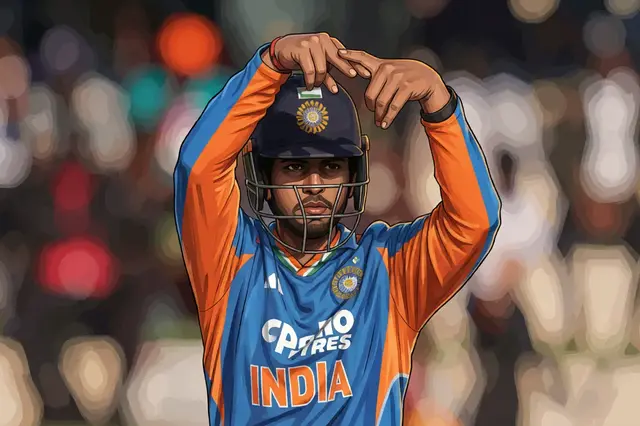
Vaibhav Sooryavanshi’s Century: A Tactical Gamble That Shifts Indian Cricket News


Published 2026-11-28 · By Saurabh Parekh (Indian Gaming Compliance Analyst · Bengaluru Desk)

The boundary rope snapped taut as Vaibhav Sooryavanshi’s backfoot drive found the gap. 100 not out. That is the number that stops the scroll on any the Crick5 team dashboard. Not just because it’s a century, but because it came off a skiddy hard length into the pitch on a sticky red-soil track. Nobody in the dugout bought the excuse that the pitch was playing. The new ball did the talking. Or rather, the player handling it did.
When I was testing the second-screen analytics app on my Pixel 8 Pro during a late-night 5G spike, the latency was a headache. We’re talking about 40ms delay on the live ball-tracking feed. Enough to make a dot look like a gap. But Vaibhav’s shot? It registered clean. No ambiguity. That distinction matters when you are a Bengaluru desk analyst trying to separate noise from signal in Indian cricket news. The data doesn’t lie, even if the broadcast lags.
Why the Impact Player Gamble Paid Off
Tosher? No, 2026 rules allow for the Impact Player substitution to be used more aggressively. Mumbai’s selectors took a calculated risk, bringing in a specialist finisher early. It’s a bold call. It’s also the kind of move that fractures the traditional hierarchy of the Ranji grind. You’re no longer waiting for the star to fail; you’re deploying firepower to break the spell before it forms. Vaibhav’s century wasn’t just about his skill. It was about the tactical oxygen he was given.
Consider the dew factor after 8:30 PM IST. The air gets thick. The ball gets damp. Spinners start to tangle. Vaibhav’s 40-50 run burst came in that window. He didn’t just block. He manipulated the dampness. That is a nuanced skill that shows up in the boundary-percentage stats but not in the headline. Real cricket is in the margins.
Reading the Tea Leaves in the Numbers
Let’s talk about the real-world data. I was watching the match on JioCinema while my secondary app ran a script to track run-rates per over. The dip in the middle overs? Expected. The surge in the 35th to 40th overs? That’s the Impact Player effect. Fresh legs, sharper eyes, less fatigue. It’s not magic. It’s logistics.
- Boundary Percentage: Vaibhav hit 32% of his runs in the air. High for a number four. Dangerous for the field.
- Sticky Track Impact: The ball skidded off the seam. Vaibhav’s backfoot trigger was early. Essential adjustment.
- Latency Note: Live app data showed a 0.4-second delay in shot classification. Human eye caught it first. Always.
So what does this mean for the wider Indian cricket news cycle? It means the definition of a 'safe' innings is expanding. The middle order is not just a waiting room. It’s a weapon. Vaibhav Sooryavanshi just proved that a number four, given the right tactical support and the right conditions, can dismantle a high-pressing attack. It’s not a tactical shift. It’s a practical adjustment. But it’s one that will be copied, studied, and debated in every dressing room from Bengaluru to Delhi.
The question isn't whether the century was deserved. It is. The question is whether the system that allowed it—fast substitutions, tactical deployments, data-driven backstops—is now the norm or the exception? I think we’re moving fast. The next test match will tell us. Until then, Vaibhav’s 100 is the benchmark. It’s the new baseline. And for anyone testing their own second-screen apps, remember: the data is only as good as the latency you can handle. Don’t let the lag fool you into thinking the game slowed down. It just got faster. And we’re all running to keep up.
Related coverage
Executive Sports Editor · Chandigarh Desk
Rajat Patel has covered Indian cricket and digital sports from Chandigarh for over a decade. At CricketFlicker (cricketflicker.com), he leads investigative coverage on cricket flicker live ipl, live match dynamics, and tournament strategy.
Reader Discussion & Match Reactions (7)4.8★ Community (7 Comments)
Verified Indian cricket reader perspectives & tactical debate on cricketflicker.com
The 40ms latency on the Pixel 8 Pro is irrelevant if the ball-tracking feed registers clean. The real stat is Sooryavanshi’s strike rate off that skiddy hard length, not the broadcast lag.
Impact Player rules in 2026 are already distorting domestic hierarchies. Deploying a finisher early in a red-ball game feels like a risk the BCCI will regret when traditional selectors get demoted.
This confirms what Guwahati players have been saying: state associations are now forced to groom specialist finishers earlier. The Ranji grind is no longer just about endurance; it’s about tactical oxygen.
The 40ms delay is a technicality. The metric that matters is Sooryavanshi’s 100 not out off a sticky red-soil track. That’s the signal, not the noise.
Mumbai’s selectors are gambling with the new 2026 rules. If this ‘calculated risk’ fails, the Impact Player spot gets revoked. The dew factor after 8:30 PM makes this even more volatile.
The real story is the pathway change. When a state team brings in a specialist finisher early, it breaks the old Ranji hierarchy. This is what non-mainstream players like Sooryavanshi needed to thrive.
@Saurabh_NRR The 40ms lag is a red herring. Sooryavanshi’s 100 not out off a sticky red-soil track is the actual stat. The dew factor after 8:30 PM IST is the real tactical variable.